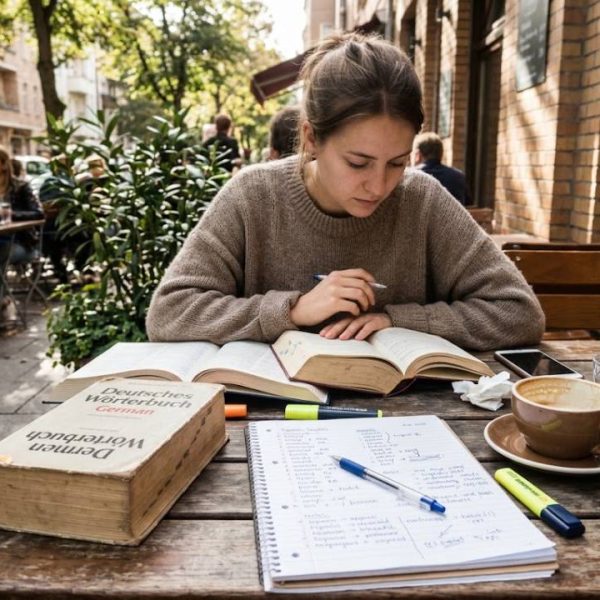
German and Spanish sit far apart on the language map. One builds long compound words, the other flows with vowels and verb endings. When you translate everyday documents between them, small habits make a big difference.
Start with the purpose of the text
Before you translate a single line, ask who will read it and why. A rental contract, a school letter and a product label all need a different tone.
A formal letter in German often uses "Sehr geehrte Damen und Herren". In Spanish, "Estimados señores" is the usual match. The goal is not a copy of the words but the same effect on the reader.
Watch out for false friends
Some words look alike but mean different things. The Spanish "embarazada" means pregnant, not embarrassed. The German "Gift" means poison, not a present.
Keep a short list of such traps. Reading it before you hand over a text saves you from awkward mistakes in emails, forms and menus.
Word order and sentence length
German often places the verb at the end of a clause, while Spanish keeps it closer to the subject. Long German sentences are better split into two or three Spanish ones.
Clear, shorter sentences read more naturally and reduce the risk of misunderstanding.
Gender, formality and regional choices
Spanish varies widely between Spain and Latin America. A word that is polite in Madrid may sound odd in Mexico City. Choose the variety that matches your reader.
German has its own splits between Germany, Austria and Switzerland. If you are curious how widely the language travels, see our overview of the countries where German is an official language.
When to bring in a professional
For personal notes, a quick tool may be enough. For contracts, certificates or anything official, a human specialist is the safer choice. Professional German translation services know the formats that offices expect and can add a certification when needed.
Numbers, dates and addresses
Dates, decimals and street addresses follow different patterns. German writes 1.234,50 and Spanish usually does the same, but many Latin American countries swap the symbols. Always check the destination country.
Addresses also change. A German street name comes before the number, while a Spanish one may include floor and door letters. Keep those details exactly as written.
Everyday documents that often need translation
Typical examples include rental agreements, utility bills, school reports, medical notes, insurance forms and employment letters. Each has special vocabulary and a fixed structure.
Learning the structure helps you spot missing information. If the original has a signature line, a stamp or a reference number, the translation should show it as well.
Build your own glossary
Keep a simple spreadsheet with German terms on the left and Spanish terms on the right. Add notes about context and the source of each choice. After a few projects you will have a reliable tool that speeds up every new text.
Share the glossary with colleagues or family members who help you. Consistent wording builds trust, especially in business letters.
Reading the result aloud
A simple test catches many problems. Read the final text out loud. If a sentence feels clumsy or you run out of breath, rewrite it. Natural rhythm is a sign of quality in both languages.
Learning resources worth bookmarking
For learners who want to improve their German alongside translation practice, the Goethe-Institut offers courses, exercises and cultural material that can sharpen your skills.
Common mistakes to avoid
Do not translate idioms word for word. "Ich verstehe nur Bahnhof" does not become a sentence about a train station in Spanish. Find the matching idea, for example "me suena a chino".
Also avoid mixing styles. Pick one level of formality and keep it from the first line to the last.
Using technology wisely
Machine tools are fast and handy for getting the gist of a message. They struggle with tone, humour and technical terms, so treat their output as a draft rather than a finished text.
A good routine is to run the draft through a tool, then check every sentence against the original. Pay extra attention to negations, numbers and names, where errors hide most often.
Practising with real material
The best way to improve is to translate things you actually care about. Try a recipe, a short news item or a letter from a friend. Compare your version with a native speaker and note every difference.
Over time you will notice patterns, such as how German nouns become Spanish verbs or how Spanish adjectives follow the noun. These patterns make future translations faster and more natural.
Working with a bilingual partner
If you know someone who speaks both languages, ask them to read your work. A short comment such as "this sounds stiff" is often more useful than a long grammar lesson.
Offer something in return, like proofreading their English, and you will build a small circle of support that helps everyone grow.
Final advice
Translate with the reader in mind, check every detail twice and ask for professional help when the stakes are high. These habits turn a stressful task into a manageable routine.